
Dispersion focuses on how individuals are arranged in their environment. There are three types if dispersion patterns: random, clumped, and uniform. These describe the different ways organisms space themselves out.
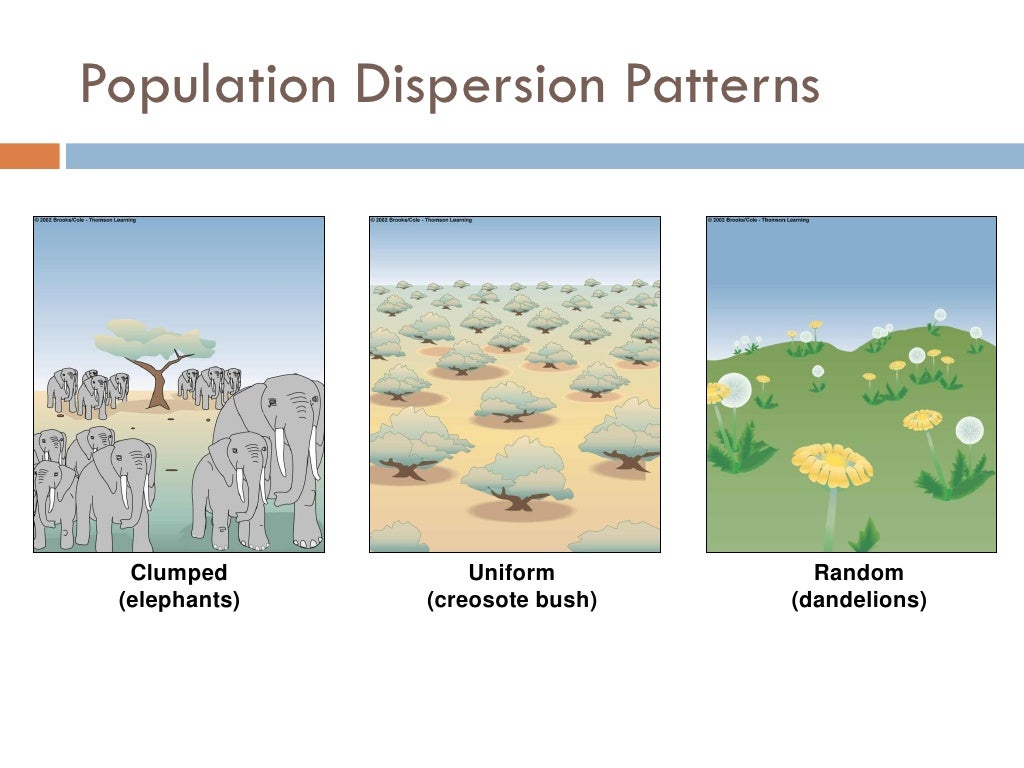
A random pattern is the most rare type. It happens when there is no correlation between the living and nonliving factors in an environment. We typically use this pattern to base our hypotheses on and call it the null model. A good example of this would be dandelions. They become randomly dispersed by the wind carrying their seeds to different places. A seed could land very far or very near to another, and none of it depends on available resources or survival.
When organisms exhibit the clumped pattern, it s typically because they are gathering around a shared resource. Elephants at a watering hole, or plants growing along a creek bed are both examples of this pattern. Anytime individuals are tightly packed together, it is considered clumped.
The last type of pattern is the uniform, or regular. When this behavior is being exhibited, the organism is territorial or fighting for resources. These individuals tend to align themselves in a way that separates them from any negative impacts that would occur if they were too close together. This happens with the sage plant. It excretes a toxin that kills all plants around it, so each individual stays a set distance away from another.
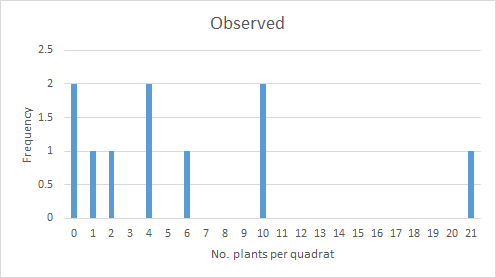
We looked at the dispersion patterns of Paspalum dilatatum. or dallisgrass, in our local cemetery. Based on observations we made in the field and what we know about this species, we expect our data to show a clumped pattern of dispersion. The amount of dallisgrass in each of our quadrats ranged from none all the way up to 21. However, when we looked at the surrounding area around the outside of the quadrat, there seemed to be little or no individuals. This is what lead us to believe that they tend to group or clump together around a particular resource.

When looking at resource availability, we are mostly interested in the density of organisms within a certain area. By taking the total amount of individuals we found, 58, and dividing it by the area we surveyed, 10 square meters, we can find the density of dallisgrass in this area. We found that the density of P. dilatatum in the Chattanooga Confederate Cemetery is 5.8 organsims per square meter.
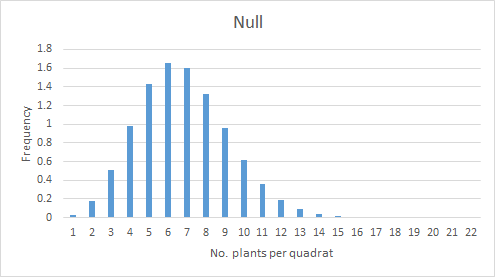
The graph above of the null hypothesis is showing what we would expect to see occurring in nature. The graph below is showing what we actually saw occurring. The observed pattern appears to be clumping around resources, so the data supports our hypothesis. Since only one quadrat had 21 organisms, we are considering it an outlier. It can basically be disregarded because the dallisgrass does not appear anywhere else in the cemetery at such a large quantity.
Dallisgrass grows during the warm, wet months. It blooms in March, and stays around until the first frost of the year comes. With increasing temperatures occurring due to climate change, the possibility of it staying in bloom all year long is continuously growing. This could mean less nutrients for any plants around it or even stiffer competition arising. “Dallisgrass (Paspalum dilatatum) is well adapted to the Black Belt physiographic region of the southeastern United States,” meaning that any small change to its environment could throw it off completely (Bungenstab, et al. 2011).
We are seeing a shift in plants in recent years where they are moving down to the lower latitudes, instead of the higher ones where they can maintain a more stable temperature. Some believed this shift was due to the fact the plants preferred the heat over the harsh winters. In actuality, there is just simply more readily available water in the warmer climates than the colder ones. “Although plant populations are shifting downward toward greater water availability, they will also have to contend with an increasingly warming climate” (Balmer, 2014).
The higher latitudes are also experiencing the effects of climate change, which is leading to less snowfall during the winter. Those environments rely on heavy snow to give them an adequate water supply during the summer months, and when they are not seeing the usual amount, the entire ecosystem can suffer. This means the dallisgrass in the Chattanooga area may soon have to compete with the plants that decide it is in their best interest to move with the water instead of the temperature.
Balmer, Jennifer. (2014). Plants have unexpected response to climate change. Science. Retrieved from https://www.sciencemag.org/news/2014/08/plants-have-unexpected-response-climate-change
Bungenstab, E. J., Pereira, A. C., Lin, J. C., Holliman, J. L., Muntifering, R. B. (2011). Productivity, utilization, and nutritive quality of dallisgrass (Paspalum dilatatum) as influenced by stocking density and rest period under continuous or rotational stocking. Journal of Animal Science, 89(2), 571. https://doi-org.proxy.lib.utc.edu/10.2527/jas.2010-3102
Population demography. (2013). Lumen. Retrieved from https://courses.lumenlearning.com/boundless-biology/chapter/population-demography/
 Happy Earth, Happy People